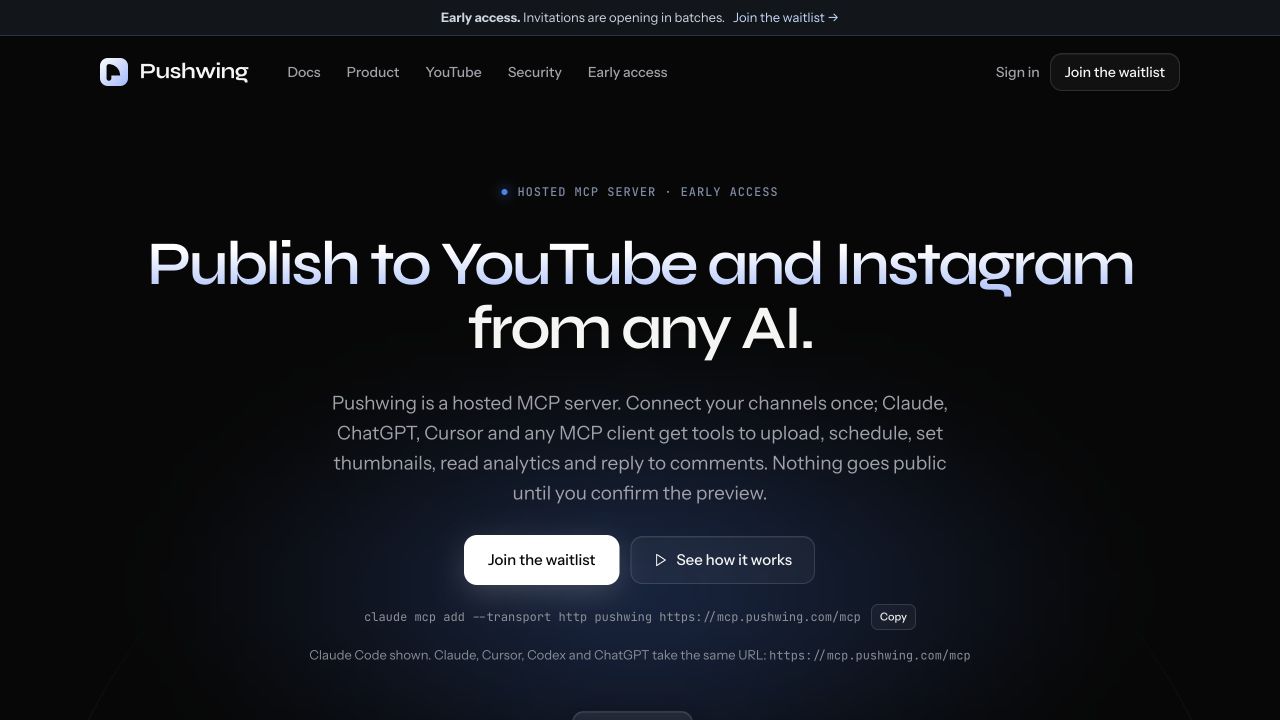
An AI-connected publishing system for YouTube and Instagram. I built the dashboard, API, hosted MCP server and the workers behind every publishing job.
ReactTypeScriptMCPBackground jobs
React + TypeScriptDashboard and reusable UI
API + MCPTwo interfaces, shared services
Async by designPostgreSQL-backed publishing jobs
01 / The challenge
A product problem,
not just a screen.
Publishing from an AI client is more than an upload call. The user needs to connect the right account, understand what will happen, and follow a job that continues after the request has finished. Those states need to make sense in a dashboard as well as through MCP tools.
What I owned
I built Pushwing from scratch: the React/TypeScript dashboard, API, hosted MCP server, shared services, provider integrations and background workers. My frontend work covers account connections, publishing jobs, usage and activity.
The system, made visible
Follow a publishing workflow
Conceptual map of the implemented components. Select a step to explore it; this is not a live publishing request.
OAuth connects a provider account. The React dashboard exposes account-connection state.
02
Request
A dashboard/API request or an MCP tool invokes the publishing workflow through shared services.
03
Process
PostgreSQL-backed pg-boss jobs and background workers perform the asynchronous provider work.
04
Inspect
Publishing-job, usage and activity interfaces expose the work to the user, supported by audit logging.
02 / Engineering decisions
01
Make server state a first-class UI concern
What I built
I used TanStack Query for dashboard data and an OpenAPI-generated API client, alongside reusable interface components.
Why it matters
Account connections and publishing jobs are changing server state. A typed client keeps the API contract explicit; query-based data handling gives those screens a consistent foundation.
02
Share the workflow, not just the types
What I built
The dashboard/API and MCP tools use a shared service layer for account, media, publishing-job and provider operations.
Why it matters
A user can enter through a visual interface or an AI client. Shared services put the core publishing behaviour behind both entry points.
03
Separate the request from the publishing work
What I built
I implemented PostgreSQL-backed jobs with pg-boss, provider integrations, OAuth, token-refresh workers and audit logging.
Why it matters
The frontend needs a job to follow, rather than tying the whole experience to one long-running HTTP request. Usage and activity views make the background work understandable.
03 / Evidence & results
A working publishing product with a shared foundation for dashboard and AI-client workflows.
The public product and existing walkthrough are available below. Pushwing is in early access: YouTube uploads remain private while API review is pending, and Instagram access is invite-only. No adoption or performance benchmark is claimed here.
Public product website · Early access
See the product in motion
The existing public Pushwing walkthrough. Play on demand.